

The cost of building a supported housing scheme of 16 properties on a rare ecological site in the south of Bath will cost more than £10 million, it has emerged.
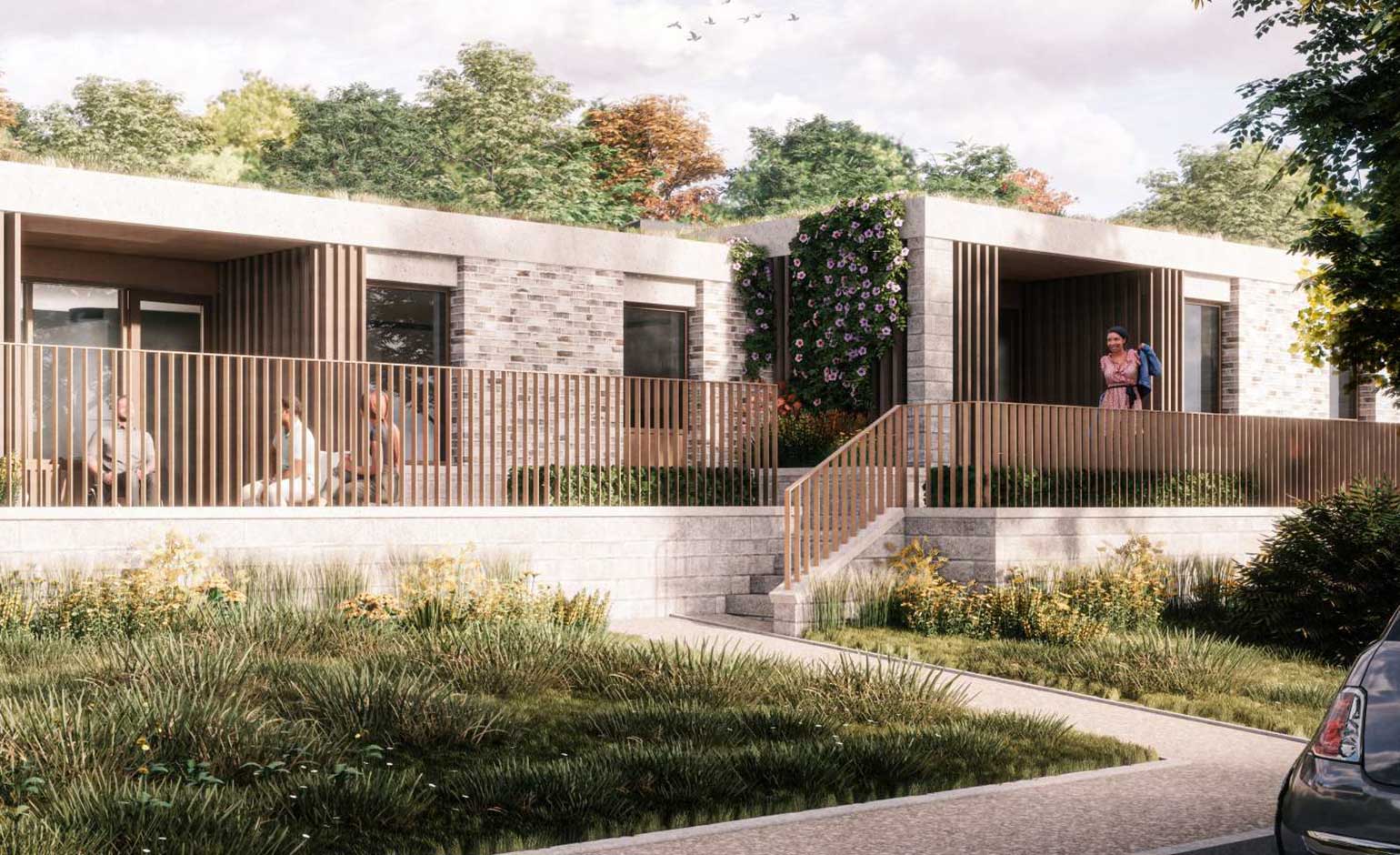
How the development will look | Image © Arcadis / Bath & North East Somerset Council
Last September Bath & North East Somerset Council secured planning permission for a social rented development on the site known as the Tufa Field, which it owns.
The land is behind 89-123 Englishcombe Lane and the scheme is part of the B&NES Homes Programme.
The houses have been specifically designed to enhance the lives of adults with learning difficulties and /or autism spectrum disorder by minimising potentially distressing environmental factors and supporting the residents in reaching their full potential.
The council has said that extensive consultation and engagement was carried out in the lead-up to the planning application being submitted, which significantly influenced the scheme’s design.
The development includes 10 one-bed single-storey houses; five two-bed houses, of which one will be single-storey and four two-storey; a three-bed single-storey house and a community hub for residents. All will be built to ensure accessibility and adaptability for wheelchair users.
The site adjoins Stirtingale Farm, which is a Site of Nature Conservation Interest (SNCI), and that designation extends to the land that will be developed.

The Tufa Field in Bath
It contains Tufa flushes, a rare type of limestone spring, and is home to a variety of wildlife. It is also the natural drainage slope for the hill of Odd Down.
The council has said the landscape-led scheme will protect the ecology of the site and incorporate flood and drainage considerations.
The principle of development on the field was accepted five years ago when the council’s planning committee granted permission, subject to completion of a legal agreement and compliance with 34 planning conditions, for 27 open-market homes.
That was shelved in favour of the subsequent planning application for a supported living development.
The plans received 46 objections and five comments of support for the proposals.
The key areas for objection were that is it an unsuitable location for the proposed use; harm to ecology and biodiversity; loss of trees; harm to the area’s appearance, character and heritage; increased flood risk; overlooking and harm to neighbours’ amenity; highway safety issues on Englishcombe Lane; issues with storage and collection of bins; crime and security concerns; and the possibility that it will pave the way for future development.
But the council’s conservation, landscape, archaeology, highways, ecology, arboriculture, drainage and flooding, sustainable construction, environmental health and contamination teams all reviewed the application and raised no objections.
The site will have eight car parking spaces and six cycle spaces. Access will be a revised version of the existing one from Englishcombe Lane between numbers 87 and 89.
Nine trees will have to be removed and there will be build-outs to improve visibility.
Construction, which it is anticipated will take 20 months, had provisionally been scheduled to start this summer.
Now the cabinet, which next meets on 11th September, is being asked to agree the allocation of £10.122 million capital funding for the proposed development.