


According to Bath Spa University, there’s a science behind writing groan-worthy gags, and Christmas cracker joke writers have more in common with one-liner comedians than you might think.
Chris Head, Associate Lecturer in Comedy at Bath Spa University, has explored the cross-over and explains how you can write your own alternative cracker jokes, as the final countdown to Christmas begins.
It’s all in the structure
First up, structure. Christmas cracker jokes are usually in the Q&A format. The question is the set-up to the joke, and the answer is the payoff. The humour is based on wordplay.
There are many ways of coming at a wordplay gag. One common approach is to play with rhymes. The word ‘elf’ does a lot of work in Christmas crackers, for example:
“Why did Santa’s helper see the doctor? Because he had a low ‘elf’ esteem!
“Did Rudolph go to school? No. He was elf-taught!”
Begin with the payoff
These jokes begin with the payoff – elf-esteem / elf-taught – and then worked backwards to write a set-up to fit. This is exactly the process that one-liner comics often use. Start with the payoff and work backwards.
For stand-ups however, rhyming wordplay is much less common. Maybe it just sounds too much of a groaner when it’s a rhyme. But for cracker writers, groaners are their bread-and-butter – the bigger the groan the more successful the joke. Eliciting a response about how terrible the joke is, is part of the fun.
Wordplay: Homophones
Another type of wordplay is to use a ‘homophone’, and this is where Christmas cracker joke writers and stand-up comedians meet. A homophone is when two words are pronounced in the same way but differ in meaning or spelling; for example ‘bear’ and ‘bare’. Here are some simple homophone cracker joke:
‘What did Santa say to his three gardeners? Hoe, hoe, hoe.’
“How does Good King Wenceslas like his pizzas? One that’s deep pan, crisp and even!”
Whilst few stand-up comedians would deliver this kind of punning Q&A joke on stage, one-liner merchant Milton Jones uses homophones like this one:
“You know the animal that kills the most people in the world? The Hepatitis Bee.”
To write a homophone joke think of some Christmas phrases and look for homophones. The homophone becomes the payoff. Now the task is to write the set-up, and this is where the real creativity happens.
Sounds like Christmas
Finally, another neat way of approaching joke-writing is to take a Christmas or wintery sounding word and find an alternative meaning for it – and then write a set-up to fit:
“What do you get when you cross a snowman with a vampire? Frostbite!”
Finding a different meaning in an everyday phrase is a technique that Milton Jones also employs – this time reversing the formula so the phrase is in the set-up instead of the pay-off:
“I hate sitting in traffic, because I always get run over.”
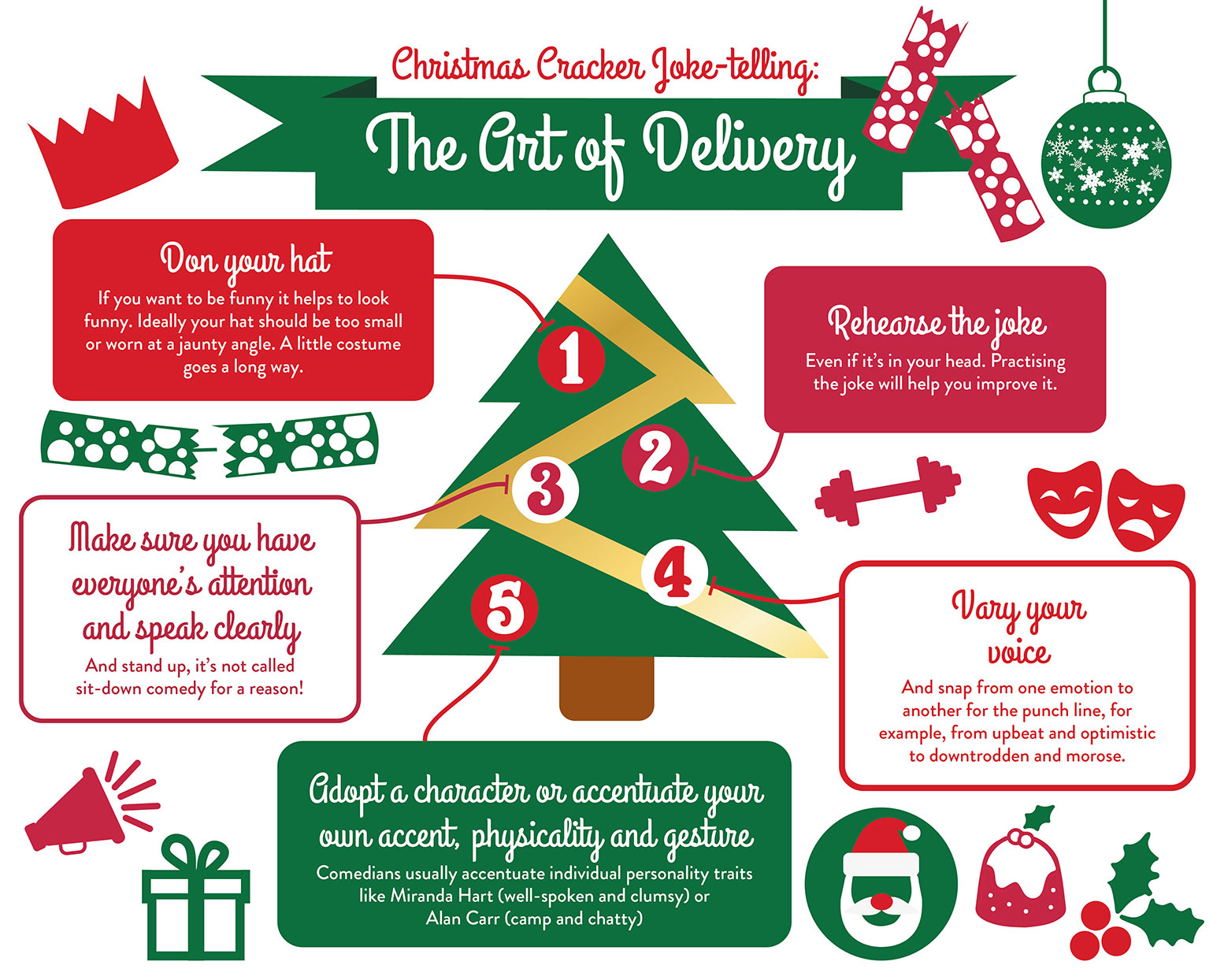
Christmas Cracker Joke-telling: The Art of Delivery
If you haven’t got time to write your own jokes and are stuck with a Christmas cracker clanger, the secret is in the delivery.
Pat Welsh, Senior Lecturer in Acting at Bath Spa University, shared his top tips for Christmas joke-telling success:
- Don your hat. If you want to be funny it helps to look funny. Ideally your hat should be too small or worn at a jaunty angle. A little costume goes a long way.
- Rehearse the joke – even if it’s in your head. Practising the joke will often help you improve it.
- Make sure you have everyone’s attention and speak clearly. And stand up, it’s not called sit-down comedy for a reason!
- Vary your voice – and snap from one emotion to another for the punch line, for example, from upbeat and optimistic to downtrodden and morose.
- Adopt a character or accentuate your own accent, physicality and gesture. Comedians usually identify an on-stage persona that can be a fabricated character such as Lee Nelson – ‘chirpy chav’ – but more commonly an accentuation of individual personality traits like Miranda Hart (well-spoken and clumsy) or Alan Carr (camp and chatty).