

The decision to make Bath’s three latest traffic restriction trials permanent has been upheld after a three-hour scrutiny meeting at the Guildhall in front of a packed public gallery.
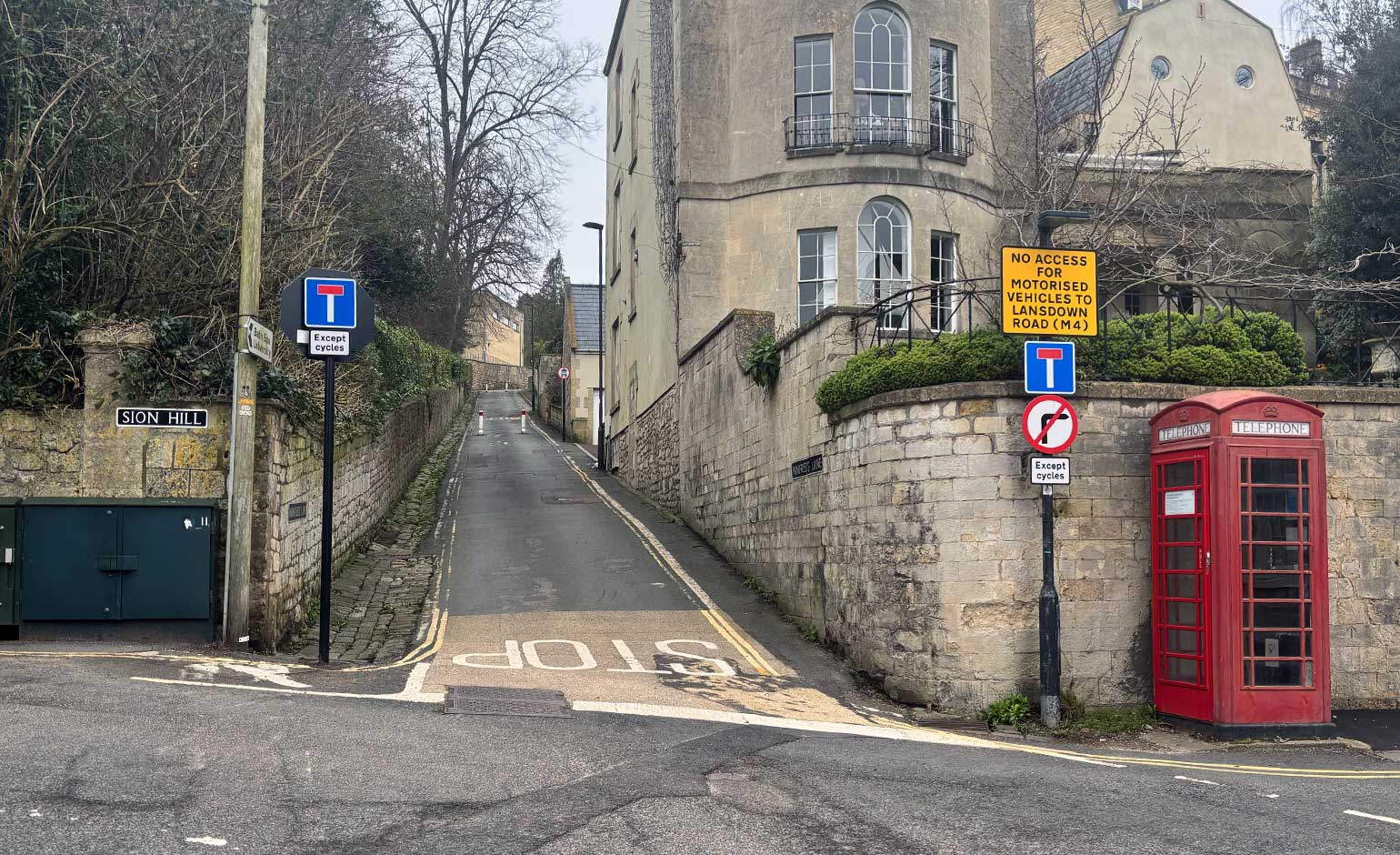
The restriction in place in Winifred’s Lane in Bath
The controversial decision to make the Liveable Neighbourhood (LN) scheme for Winifred’s Lane, Gay Street and Catharine Place permanent was signed off at the end of January by the council’s Liberal Democrat cabinet members Manda Rigby (communications and community) and Joel Hirst (sustainable transport strategy).
But after a call-in request by a cross-party group of nine councillors, the panel met yesterday, Monday 23rd February, when they were tasked with making one of three options: to ask the cabinet members to rethink, for the decision to go to full council, or reject the call-in.
While the three trials are independent of each other, Bath & North East Somerset Council designed them to work together. There is a through-traffic restriction on Winifred’s Lane, a through-traffic closure at Catharine Place and a ‘no entry’ and turning changes on Gay Street and around The Circus.
The aim is to enable more local trips by active travel and address excessive traffic on residential roads often used as short cuts to and from the A46 and M4 north of the city.
The trial that’s divided public opinion is Winifred’s Lane, where bollards now prevent traffic from the narrow route which was previously used by 1,300 cars a day.
The council’s own consultation found 84% of respondents were in objection to the Winifred’s Lane trial. Even within the immediate trial area, 72% of residents opposed the scheme.
Thirteen members of the public, both for and against the scheme, addressed the panel yesterday.
A resident of Upper Lansdown Mews affected by the closure of Winifred’s Lane said: “More than half a million additional vehicles have now been sent past two junior schools per year through closing Winifred’s Lane.”
He highlighted that a four-tonne lorry had written off a resident’s car on the blind bends of Sion Road, which was reported but didn’t appear anywhere in the council reports.
A representative of the Heart of Lansdown Conservation Group said the council’s own numbers show an additional 1,649 km per day being driven around the Winifred’s Lane area due to displaced traffic, equating to over 30 additional tons of carbon emitted per year.
Other speakers praised the council for its thorough consultation. One said Winifred’s Lane has been transformed into a “vibrant active travel area”.
Local councillors voiced their support for the LN to the panel. Mark Elliott (Lansdown, Lib Dem) said the aim of the Winifred’s Lane scheme is to discourage northbound through traffic cutting through and there has been a significant reduction.
He said drivers still choosing to take a short cut are now going around the western part of Sion Hill and Sion Road and he would “absolutely” like to see northbound traffic reduce further. He said more could be done, including working with the schools further up the hill to reduce school-run traffic.
He said Winifred’s Lane was a “potential pedestrian death trap” when 1,300 cars a day were hurtling up the lane and the scheme has reduced northbound traffic by 40%.
Councillor Lucy Hodge (Lansdown, Lib Dem) said there are now increased numbers of cyclists, schoolchildren and walkers using Winifred’s Lane. She recognised the differences in opinion amongst the residents she represents and said she had taken on board all comments received.
Councillor Hodge said mostly school-run traffic is still choosing the winding route along Sion Road, “impatient at the need to give way”, and that mitigations would deter pavement driving.
Councillor Paul Roper (Kingsmead), also speaking for fellow Lib Dem ward Councillor George Tomlin, said: “This administration is not anti-car, but we are simply not putting the car first.”
Although the scheme “is not perfect”, he said statistics are showing favourable results. He added that a significant proportion of objectors do not live in the area and “are the very commuters who we are encouraging to use alternative main roads”.
Councillor Colin Blackburn (Westmoreland, Independent), the call-in’s lead member, told the panel: “I speak today on behalf of the hundreds of residents in the Lansdown part of this LN who feel unrepresented and frustrated by the lack of genuine consideration for the consultation and the facts.
“Maybe the recent comment by the leader of this council to ‘back off’ when questioned about consultation results is indicative of the attitude of this administration that surrounds this decision and why residents feel this trial was pre-determined.”
Councillor Blackburn said cross-party councillors who made the call-in could not understand how Councillor Elliott could use the argument of 72% in favour of an LN in a fellow cabinet member’s ward (New Sydney Place and Sydney Road in Manda Rigby’s Bathwick ward) to justify pushing through his decision last year to make that LN permanent, only to do the exact opposite now.
“He is not arguing on his residents’ behalf for the decision makers to remove Winifred’s Lane as part of these linked ETROs (Experimental Traffic Regulation Orders). Those residents feel abandoned,” said Councillor Blackburn.
Residents’ safety and voices had been “sidelined in favour of a theoretical model that has failed its real-world test”.
He said by closing Winifred’s Lane, the council has deliberately displaced traffic onto residential routes and past junior schools. The recommendation to make the trial permanent rested on “unsound data” with critical metrics including speeds and carbon emissions omitted from the reports.
Councillor Blackburn described the linking of the trials as “arbitrary” with no stated legal basis and urged the panel to send the decision back to cabinet members for review and encourage them to separate and revert the Winifred’s Lane ETRO.
Councillor Joel Hirst (Odd Down, Liberal Dem) told the panel that the call-in notice contained nothing that wasn’t considered in the decision-making process. He said both he and Councillor Rigby were satisfied that based on evidence, the Winifred Lane intervention, in tandem with the other two, has proved to work and had met the objectives. “We’ve got no reason to believe that the data provided isn’t sound.”
He said there had been some “displacement” and there are mitigations to work on that. The three linked schemes are reducing through-traffic in predominantly residential areas and safety and regulations were considered “very carefully”.
Councillor Rigby said both she and Councillor Hirst had separately come to the same conclusion that the right thing was to make the three schemes permanent: “We do not accept that the data we have used isn’t sound.”
Scrutiny panel member Councillor Eleanor Jackson (Westfield, Labour) asked about the costs of the consultation to council taxpayers. Councillor Hirst said the West of England Combined Authority (WECA) was providing £9.4 million of funding across the whole LN programme.
Pre-empting a possible legal challenge, panel member Councillor Duncan Hounsell (Saltford, Lib Dem) said that looking at the reasons that people could use at a judicial review, he did not feel the decision-making process could be challenged.
Panel member Councillor Malcolm Treby (Weston, Lib Dem) pressed Councillor Rigby on whether the Winifred’s Lane scheme would be successful without the mitigations.
She said looking at the data and evidence, the scheme meets all targets without mitigations being put in, but they have acknowledged there may be a need to look at doing some.
Councillor Toby Simon (Bathwick, Lib Dem) said he believed the scheme has clearly achieve what it set out to do while fellow panel member Councillor Tim Ball (Twerton & Whiteway, Lib Dem) said the arguments put by Councillor Blackburn don’t challenge the procedure that was taken, and the cabinet members had clearly taken into account the issues raised at consultations.
Panel member Councillor Joanna Wright (Lambridge, Green) said it was clear lots of people want the scheme to be successful, but lots are still unhappy about some of the detail and “there seem to be grey areas”.
Towards the end of the debate, she said: “I am disappointed by this process. I am disappointed by this scrutiny panel because as far as I can see a group of people haven’t even asked a question of the two cabinet members in front of us when their job is to scrutinise them.”
The panel voted to reject the call-in by six votes to one, with two abstentions.